Creating art with AI is not the same thing as AI art.
AI art is when you type a prompt and something spits out an image. You might refine the prompt, you might iterate, but the creative act is largely outsourced. The AI is the artist. You’re the client. That has its place, I use image generators in my work every day and I post about it quite frequently. But it’s not what I’m talking about here.
I’m talking about using AI as a collaborator in a creative process that’s still fundamentally yours. Where the concept, the meaning, the why comes from you, and the AI helps you build the vessel.
I create mandalas by hand. It’s a spiritual practice rooted in years of study, Tibetan Buddhism, Jungian psychology, contemplative traditions. Recently I wanted to explore whether algorithmic art could carry the same kind of intentionality I bring to my physical work. Not replace it. Extend it into a different medium.
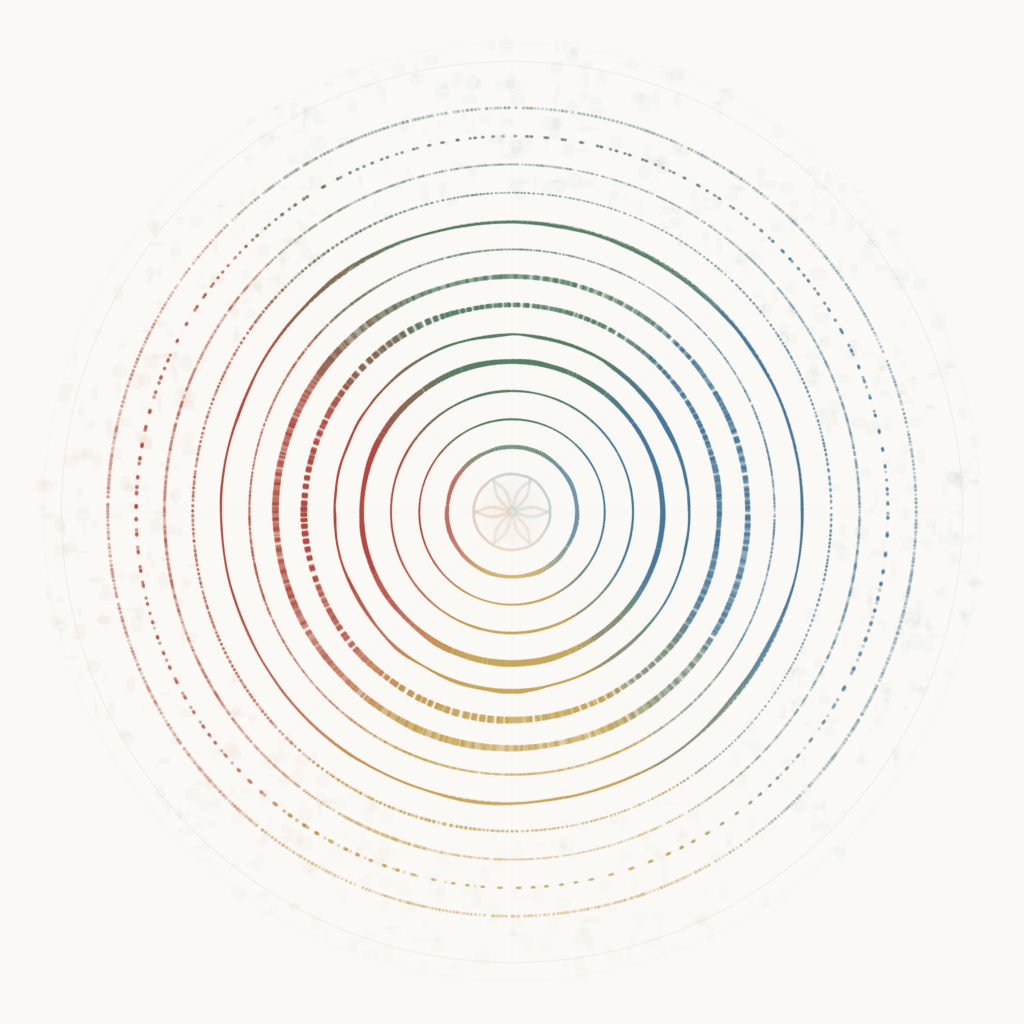
So I sat down with Claude
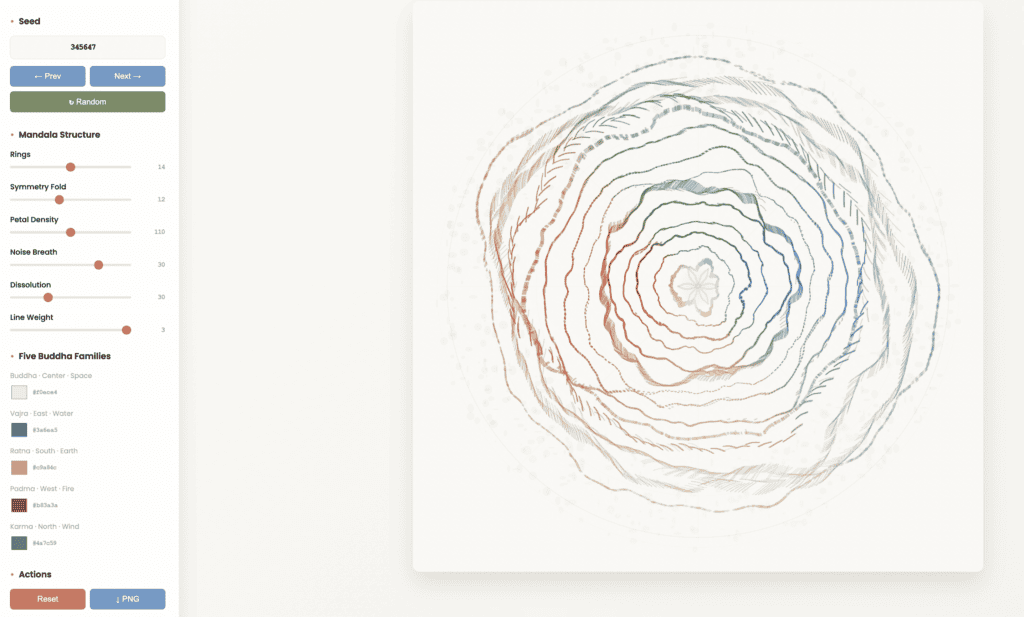
and we built a mandala generator from scratch. Not by typing “make me a mandala.” By writing an algorithmic philosophy first, a document called Dependent Arising that mapped the conceptual framework onto computational logic. The Five Buddha Families became five color zones positioned at the cardinal directions. The Buddhist concept of dependent arising, that nothing exists independently, everything is defined by its relationships, became the rule governing how every mark on the canvas relates to the center, to its angular siblings, to the ring it sits in, and to the seed that generated it. The Tibetan practice of building and sweeping away sand mandalas became a “dissolution” parameter where outer rings lose coherence and return to void.
The AI didn’t come up with any of that. I did. The AI wrote the code that made it run. It translated my conceptual framework into math, radial symmetry with noise perturbation (radial symmetry with a subtle wobble), color fields that bleed at boundaries the way energies coexist in the psyche, each seed collapsing infinite potential into one particular form.
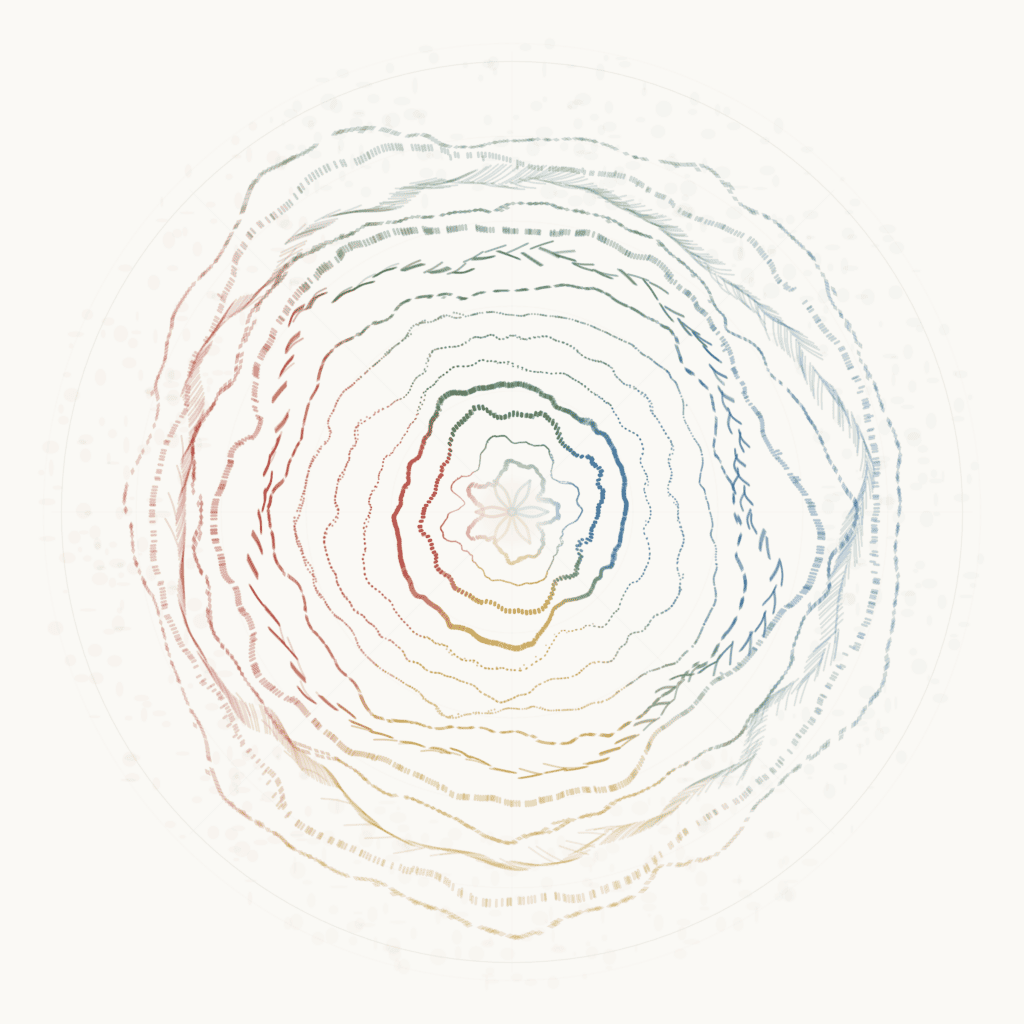
What you get is something neither could have made alone, because it’s instantly interactive and inspiring, so now I can take these roughs and I can go build this out of leaves and string, or a 3D print.
I think we’re early in understanding, what this collaboration looks like. Most of the conversation right now is about AI replacing artists, and some of us are still talking fear-based or what the future holds for all of us. Seems like this great wide unknown. I’m interested in what happens when artists use AI the way they use any other tool, with intention, with craft, and with something to say.
TOOLS USED IN THIS POST
I’m on Claude Opus 4.6 the most advanced model in the Claude 4.5 family. It’s the top-tier model, and I’m accessing it through the Max plan.
Claude offers skills on different things and I will cover them as I learn to use them but I started in art because that’s where I learn…
- Algorithmic Art — the p5.js generative mandala generator
- Canvas Design — the static PNG “Vigilant Geometry”
- Frontend Design — the React artifacts (flow fields, pixel re-rendering engine)
The algorithmic art skill is the one I went deepest with for the Dependent Arising project.


Hello Michelle,
Most Clear. Your add another creative tool to your inventory of your creative processes.
You described just as well, the 1st time you used an AI to alter a large colorful Bird Art that you had done, and used AI to much more quickly generate various permutations of the Bird Art but only by you telling AI where and how you wanted to see a variety of changes in the Bird’s look mostly in Color and Size Variations as best as I can recall. It was likely over a year ago.
It was as clear to me the first time you used AI as Tool that was an extension of your creativity and of your creative tastes and judgements of what you think is attractive in a final work of art.
Hello Michelle,
The detailed language and specific intentionality, just makes It Seem that much more clearly that your making so many specific decisions, when doing so in Buddhist Symbolic Artist creations.
But it was equally clear to me from the very 1st colorful Bird Art that you made so many
distinct exploratory permutations of.
You just have now twice proved your point, perhaps with help of a Buddhist overly deterministic structured point of view !
Any versatile Tool will produce different results in the hands and brain that guides it. Humans use their creativity all so differently and in so many varying degrees of interest.
Regards, Don
http://www.KeiserNewman.com/web/ http://www.StretchDevices.com
Thank you, Don. I forgot about the bird art. That was a while ago. I’m glad you remembered.