We ran a post back in 2014 about a silkscreening nun named Sister Corita Kent. Her connection to screenprinting was mostly a footnote at the time—she had just popped up as a Google Doodle. Honestly, most of us didn’t know much about her. But the more you dig into Corita Kent’s screenprinting legacy, the more you realize she’s one of the most important printers in history—and her work is having a major moment right now.
Here’s the rundown.
Born Frances Elizabeth Kent in 1918, she entered the Sisters of the Immaculate Heart of Mary in Los Angeles at 18 and spent three decades teaching art at Immaculate Heart College, eventually chairing the department. During that time, she created nearly 800 original serigraph editions—bold, colorful screenprinted works blending pop culture with scripture and social justice. Think Andy Warhol meets activism. Warhol himself praised her work, and by 1967 she was on the cover of Newsweek.
If you’ve ever driven I-93 through Boston, you’ve seen her most visible piece. The Rainbow Swash—that giant rainbow on the 140-foot gas tank in Dorchester—was commissioned in 1971. It’s considered the largest copyrighted work of art in the world. There’s a long-running debate about whether the blue stripe contains a hidden profile of Ho Chi Minh, given her anti-war activism. She never confirmed or denied it.
Then there’s the stamp.
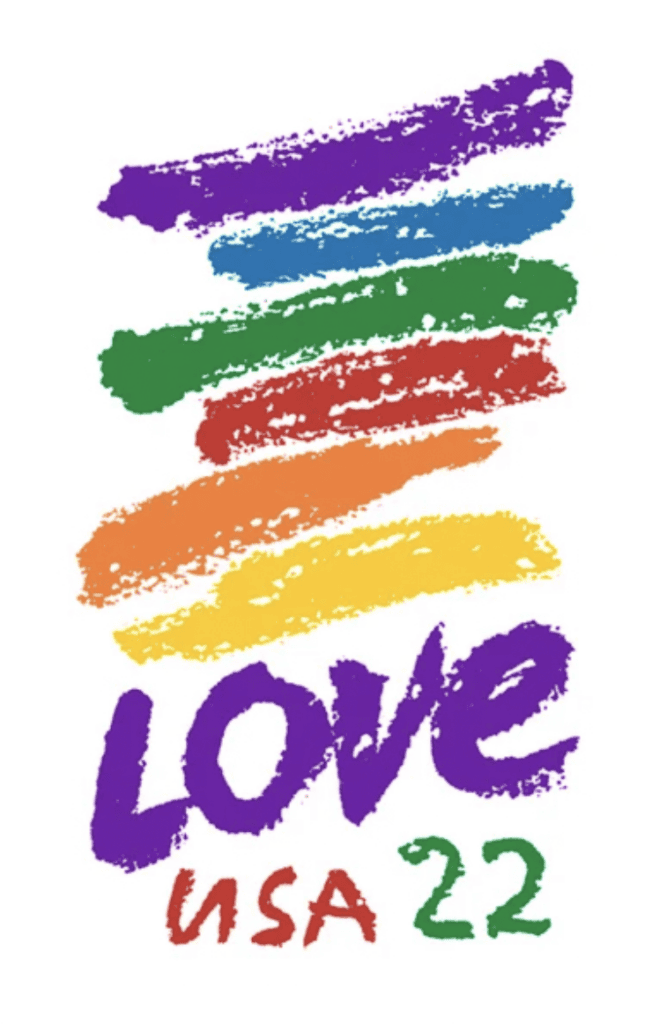
In 1985, the U.S. Postal Service commissioned her to design the Love stamp. Over 700 million copies were sold. Some collectors called the brushstroke design too simple and nicknamed it the “lipstick stamp.” Kent had envisioned an unveiling at the United Nations. The USPS launched it on the set of The Love Boat instead. She didn’t attend.
Kent passed away from cancer in 1986, but her legacy is only growing. A dedicated Corita Art Center opened in the LA Arts District in March 2025 with a $5 million grant to preserve her work. The center’s collection includes serigraphs, thousands of watercolors, sketches, photographs, and archival materials. Her art hangs in the Met, MoMA, the Whitney, and the Centre Pompidou. The Marciano Art Foundation in LA ran a major exhibition of over 1,100 of her photographs through January 2026, and her Los Angeles studio was designated a Historic-Cultural Monument in 2021.
What I find most compelling is that Corita Kent was a screenprinter. She pulled squeegees, mixed ink, and made serigraphs—the same craft that drives our industry every day. Most people in garment decoration have never heard of her, and that seems like something worth changing. You can explore her stunning serigraphs at the Corita Art Center collection, the Hammer Museum’s digital archive, or browse her work on Artsy.

Comments