On this date in 1851, This Guy Started the Modern Garment Industry: Isaac Merritt Singer was granted U.S. Patent No. 8,294 for his “Improvement in Sewing Machines” and the garment industry as we know it was born.
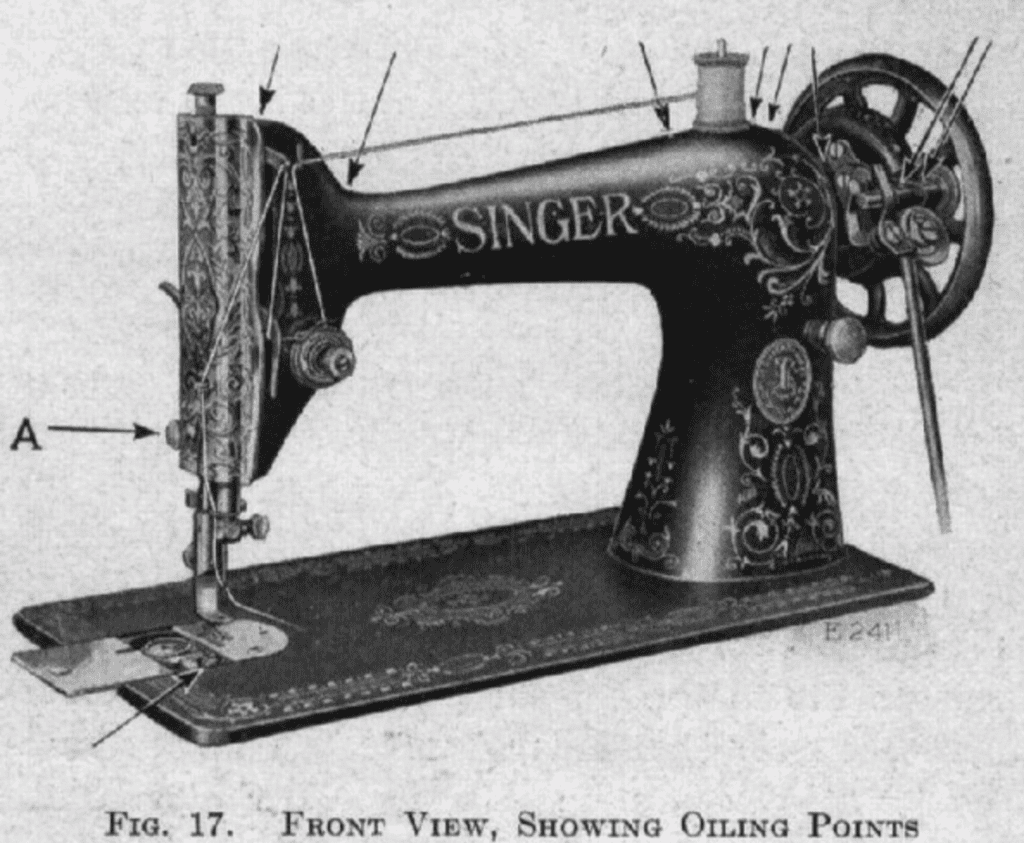
As with many famous inventors (Edison, for example), Singer didn’t really invent what we think he did. He didn’t invent the sewing machine. Many came before him, particularly Elias Howe, who held the foundational 1846 lockstitch patent. Walter Hunt and Barthélemy Thimonnier had patented earlier designs too. What Singer did was fix the practical problems that kept those machines from actually working well. Working out of Orson C. Phelps’s machine shop in Boston, he redesigned a broken Lerow & Blodgett machine. He replaced its circular shuttle with a straight-line shuttle, added a fixed arm to hold the needle, and incorporated a foot treadle that freed up both of the operator’s hands. The result: 900 stitches per minute, compared to about 40 by a hand seamstress. Today’s high-speed industrial machines reach 5,500 to 7,000 stitches per minute.
Singer also figured out how to mass-produce reliable sewing machines. At a time when the average American income was around $500 a year, his machines sold for $125. Still steep. So he did something even more important than engineering: he pioneered the installment payment plan. His “a dollar down, a dollar a week” credit program meant just about anyone could afford a machine. Customers all over the country were paying installments. By 1860 Singer was the biggest sewing machine manufacturer in the world. One of America’s first true multinational corporations. 175 years ago.
Singer died in 1875 at his grand estate in Paignton, England, leaving behind a $13 million fortune — roughly $383 million in today’s dollars. He also left behind 24 children and a legacy that made “Singer” synonymous with sewing worldwide. Even Mahatma Gandhi, who rejected most machines, made an exception for the Singer. He reportedly called it “one of the few useful things ever invented.”
And what of Elias Howe?
Howe won his patent infringement case in 1854. A federal commission declared that “there is no evidence in this case that leaves a shadow of a doubt that, for all the benefit conferred upon the public by the introduction of sewing machines, the public is indebted to Mr. Howe.” But the story didn’t end there. Singer, Howe, Wheeler & Wilson, and Grover & Baker formed the Sewing Machine Combination in 1856 — the first patent pool in American industrial history. Under this arrangement, Howe earned royalties on every machine sold. As much as $4,000 a month, over $45,000 in today’s dollars. He pocketed over $2 million by the 1860s, was awarded the Légion d’honneur by Napoleon III, and died a multi-millionaire himself.


Comments