Throwback Thursday. In October 2024 Pam Ikegami wrote up Rick’s Impressions Long Beach Shop Talk on the history of automatic presses. The panel was Rick Fuqua of Real Performance Machinery, James Ortolani of Hix, and Tom Codute of SPSI. It ends on “the future” without naming one. Nine months later a Shirt Board thread filled that in. Here’s the rundown. TBT: Sixty Years of Automatic Presses
What got automated
The press did. Pam’s post walks it in order. The first inline automatics showed up in the late 1960s, probably from Allison or Precision. Shirts didn’t come back to the operator, so setups ate garments. Squeegee and flood moved at the same speed because there were no independent heads. Operators registered with a hammer.
The Cameo was the first round automatic, also late 1960s. Operators put lead weights on the heads to push thicker inks. Hydraulic ovals indexed with a big ram and couldn’t register backward or flash between colors.
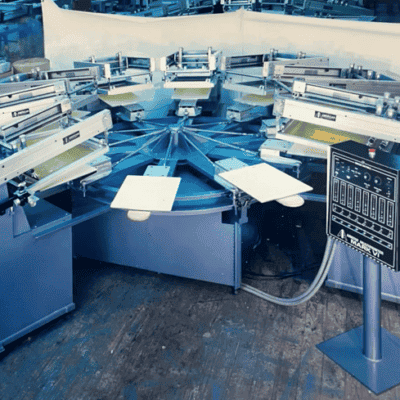
Then air. The MHM arrived in 1985 with an air-driven squeegee and flood carriage. Consistency went up. Operators relearned the machine. M&R and the Centurion followed with hand cycling and high-lift heads. Around 2000 came servos, digital off-contact, squeegee pressure readouts, and job recall. A shop running short jobs could set up by pressing a button. (For the MHM side of that story, see R.I.P. Herbert Mayrhofer.)
Every one of those changes automated the stroke. Pam’s post stops at “more user-friendly machines.” The forum picked it up from there.
What the forum said in July 2025
ebscreen opened the Automation thread with a sales call. “We were recently contacted by a robotics company that is looking to automate the loading of garments onto automatic presses.” He told them about the nuances of even unloading a garment, and that used M&R Passports sell “for pennies on the dollar these days.” Their answer was that AI would solve all of it. He responded: “Then I laughed even harder and didn’t feel bad.”
M&R already tried the loader.
Tony Pepitone: “the Passport is an unloader not loader. Worked with Rich Hoffman on the loader concept but he passed on that. Too finicky and only for mass production which no one wanted to pay for.” Evo relayed Rich Hoffman’s reason. The shirts “need to be stacked perfectly to make it work.” The labor to stack them that way cost more than a human loader. Getting them stacked that way from the mill would take “an act of God.” Evo’s close: “Go mammals.”
Shops are replacing the catcher right now.
Pierre at blue moon: “we are using a robot to catch at the end of the dryer and will soon be working on it dropping the shirts directly onto the folder.” It works well enough that he’s buying more, starting with a Dekken Stacker Joe. The catch, from ebscreen: “having a set of eyes at the end of the dryer has been invaluable.” Pierre agreed he’s losing a set of eyes. He is betting the puller and the printer are enough. Maxie saw the Dekken at FESPA and flagged the production hit. Shirts have to go through “one shirt after the other.” Fast shops run two across the belt.
AI print inspection is the next pitch, and the room disagrees. Maxie: “if you have a high quality camera AI can compare the printed and file image and pick up any differences.” ebscreen: “To a computer a slightly different fold on the garment would be enough of a difference to trigger detection,” and he can see press ops “turning the stupid buzzer off and the camera relegated to the dustbin.” mk162 added the dryer problem: over-flashed fibrillation “looks great right off the press, but will develop small white dots on them after getting hit with the final heat.” Then: “maybe it’s trainable.” A forum thread is already looking for a partner to build exactly this.
Transfers may get there first.
whitewater saw a ROQ auto heat press with a machine that drops the transfer in place. Pierre doesn’t like that: “Dropping transfers is not a good idea, they can move when the press spins.” His version: “Think directly from the roll onto the shirt.” brandon’s bet: “With powder-less DTF on the horizon this will happen. I am going to bet mid 2026, definitely 2027.” That’s the same direction as TBT: Yet-Tee: Powderless DTF Meets One-Operator Production and Losing the Powder.
ebscreen’s verdict on all of it: “when it comes to the physical process of screen printing textiles ~99% of anything that will ever be automated has been.”
Where that leaves the question
AI’s real near-term job in a print shop is the information, not the shirt. Checking art, approving proofs, remembering how a job ran last time. I’ve written about that in AI Pipeline for a Screen Print Factory and Software That Doesn’t Remember.


Comments